Sunday, July 31, 2005

Living with limits

When it comes to clothing, I am a power shopper. Given the information that management would prefer to see more formal, businesslike clothing, I spent yesterday re-engineering my wardrobe. I won’t say the transformation is complete, but I do have two closets now—one devoted to clothing that can be worn to the office (some “full business attire” consisting of suits and separates, some slightly less formal but still a step up from what I have been wearing) and one for everything else (all denim is there, along with most cotton knits, most bulky sweaters, a surprising amount of at-home lingerie and loungeware, and all the frilly and funky clothes I keep because I may want to dress up to go out someday).

The truth is that I love pretty clothes, so I have a secret discount shopping habit, which I have applied—ironically—over the last few years in systematically making my wardrobe less formal. It appeared to me that to fit in here in Vermont that I needed to be more casual, but now it appears that I have overdone the swing to the casual, and need to move back the other direction. Yesterday, I spent just under $700 and five and a half hours to score:
2 mid-weight outer jackets (for $70 for the two, I will have alternatives for most of the year)
1 suit (with pants)
3 blazers suitable for office
7 pants suitable for office (one matches a blazer I already own)
1 skirt (gray and hot pink pinstripe for $10—I couldn’t resist!)
10 shirts (most in the $7-10 range)
1 turtleneck sweater (possibly a mistake, but at $5 not a big one)
3 cardigans suitable for the less formal days in the office
3 pairs of good quality brand name shoes (Anne Klein, Born, and Capezio)
1 pair earrings
1 pair cufflinks
6 pairs of kneehighs
6 pairs of black socks (all identical because socks get eaten at my house)
I figure I still need a replacement for my winter parka, two more suits, and—when the dust settles—possibly a couple of specific fill-in pieces like a classic cream silk shirt or a pair of navy pants. It would be easier if I were less fussy about clothing, but I draw the line at frump, although I have had to relax the prohibitition against polyester, as the fabric has improved and is used more often in higher quality clothing. I almost always buy brand name clothing because it lasts longer and fits better, but occasionally I will spend up to $20 on a gamble, if I really love the piece. Like my favorite brick-red silky poly knit shirt with v-neck and four ruffles up the front—an enduring high scorer on my personal rulebook derived from all those multiple copies of What Not to Wear that people have given me.

Anyone who knows me in person may be surprised to know that I am fussy about clothing, because I am one of those people who tend to look casual no matter what I wear. It is something about my short stature, tendency to plumpness, sloped shoulders, curly hair that won’t stay combed, and a mobile face that shows everything. Over time, I have learned that I have to wear more formal clothing to get to the expected baseline than do taller, thinner, more reserved people. But that’s an easy fix, right?

It’s not really about money. It is about finding the personal style that fits, then shopping relentlessly to find clothing that really works. I don’t have the patience to shop often, so I do a couple of large shopping trips a year, then fill in gaps. I make it a policy never to buy only things that look great or that I love. Although I make mistakes sometimes, they are few and inexpensive. Since moving to Vermont, I haven’t needed to pay more than $20 for a shirt, $30 for pants, or $100 for a suit—this the impact of dramatically lower clothing prices over the last several years, as well as of my firm resolve to live within my income. It doesn’t hurt that I am handy with a needle and can make simple alterations myself or even whip up the skirt or pants that will be the perfect go-with for a purchased jacket.

Yesterday, I saw lots of jackets this year that look as if they are made out of upholstery fabric....hmmm. Maybe I will see what is in my fabric stash. As long as I don’t have to rely on my sewing skills to dress me appropriately—what frustration and anxiety that would provoke!—I can have a little fun and maybe expand my wardrobe alternatives.

One of the valuable lessons I learned in business school is that you can't optimize everything, so it is important to know what you are trying to optimize and what are the limits. The limits on my clothing adventures are a need to meet a certain appearance standard and a small budget. Within those limits, I can apply creativity, a disciplined approach, and shopping and sewing skills to optimize my wardrobe along a number of parameters--ease of getting dressed in the morning, easy care of clothing (washable, no ironing is best!), and what looks great on me. With unlimited time and money, these might seem to be much easier to optimize. My experience suggests otherwise. It can be a joy to live within limits, once we accept that they are there.

Thursday, July 28, 2005

Suits me

The fearsome performance evaluation is over, and it went as well, perhaps better than I could have expected. Because I run a small (minuscule, actually) non-profit, I report to a board of eleven members. I have eleven bosses.

Okay, I exaggerate. I only have nine bosses, because we have two vacancies. They are all volunteers, and I am the only full-time paid staff person, with a half-time assistant. It is an interesting dynamic. I am in charge of everything, and if I need a sounding board or specific expertise or backup or…anything…I have to accept that everyone may be too busy to help. From time to time there are things that simply must be communicated, and the president takes the brunt of that—the concerns about the local businessman who is a little too free with his hands, the thankfully-now-former assistant who has accused me of …well, never mind…, the political ramifications of my inability to meet every real or imagined need that has a “business” overtone. Because I was brought up in an environment where the biggest, most sacrosanct rule governing communication was “No surprises,” I communicate relentlessly. Even when the president sighs and harrumphs.

But really, he is a good guy. Can he help it if he is a very different personality type from me?

They had mercy on me. Only three came for the performance review, and they were sensitive to fact they had me outnumbered. In exchange, they gave me a gift—they flexed to my communications style, let me ramble, rant and posture as I worked through the blessedly few issues that we had to discuss. I will spare you the grim and gory details (well, actually, there weren’t any, despite the fears I bring from my years living the Wall Street staff shrinkages), but the amusing one was this: they want me to wear suits.

Suits! Who woulda thunk? Now you have to understand that there are huge numbers of non-profits in Vermont. In a state of some 600,000 people, there are three thousand non-profits—that is one for every 200 people. And these are relatively well-paying jobs that allow for personal fulfillment, casual attire, and an atmosphere in which you can bring your dog or your sick child to work. It is a great life, as long as the pyramid funding scheme doesn’t collapse. For those of us who toil in the economic development vineyards, the men do wear suits to Montpelier, and the women wear something that passes for business attire. But my board thinks I am excessively casual, that they would prefer to see a more polished presentation.

Once I got over the shock—which partly derived from the fact that nobody has mentioned this in the two years I have had the job—I can see their point. It is not a comment on my personal life choices; it is an issue of positioning and branding the organization. And as an INFP, I am routinely unaware what others see—the external face that creates confidence. Just as I am unaware of large amounts of dog hair in my car, in my office, and on the knees of my trousers. So I don’t mind being reminded that for some people, if I dress more formally, I am more credible.

Okay, so let’s not get hung up on whether I wore a denim vest to the last board meeting (even if it is really cute and flattering) or that, in fact, I always wear some version of business clothing when I visit Montpelier. Let’s instead take the whole range of choices of clothing for quiet days in the office, reconnoitering buildings (complete with dead pigeons), visits to local businesses (who demonstrate a range of dress code options), schmoozing legislators, peddling raffle tickets for Rotary...all of the varied dress occasions that my job presents. Let’s take them all up a notch on the formality scale. I honestly don’t have a problem with that.

This is the perfect time of year to make a shift. I heard a long time ago that the way to be fashion forward is to be slightly ahead of the season. So in August, the first transitional fall clothes come out, and if the truth is known, I hate almost everyone’s summer clothes. Fabric and cut, all seem too casual to me, with my taste shaped by a certain New York chic. And I draw the line at frumpy.

I didn’t put enough money in my request to take care of a major wardrobe overhaul. But the hunt for pretty clothes at low cost—that’s entertainment to me, and I will do my best to make it work.

And all they want is suits? Oh yes, and perhaps I could clean up my trading floor language, which emerges in stressful periods. What a gift! To have the option to stay and work with people who treat me with care and respect, in a job that suits.

Holding truth

It is the Eastern sensibility, not the Western way, that values the ability to hold opposing truths in the mind, unresolved. Whether east or west, I cannot say, but it is wisdom to know one’s own place in the world.

And with this in mind, I face tomorrow’s dreaded performance review, trying my best to keep in the forefront of my mind that work is more than a job, that each one of us has unique gifts, and that—occasionally—we find ourselves in the right time and the right place for our peculiar set of unique capabilities to find right expression. And then, that time is past, and we move on, in search of the next fertile field, though whether it is opportunity to exercise fine-honed skills or an opportunity to contribute in a startlingly new way, we know not. Saying goodbye is always hard, and still we trust that God would not require that forward momentum unless—at some level—we were ready.

Who was it, some French guy (Hugo? Baudelaire?), who had that beautiful turn of phrase? Something like God does not make fruit grow so heavy that the branch breaks under its weight. A beautiful sentiment, and yet any observer of nature knows it not to be true. The truth is that we are tested every day in small ways and large, challenged to keep becoming what we are meant to be. Paradoxically, the more we rise to that challenge, the more we understand the degree to which we fall short.

The two conversations within a conversation within a review that I need to have tomorrow are these:

I am different from you. In Briggs-Meyers terms, I am an INFP, statistically rare and led to express my Healer/Idealist in a harsh, foreign world of economics and commerce. Who came up with this bad joke? And yet it is my world and it is the gift I have been given. Or lent. The opposing truth: I am just like you.

I am the right person for this particular job only for a time. Maybe this is the time, or maybe the time is already past. There will come a time when what you need is a crack administrator or a true visionary or maybe just someone to clean up the mess. I don’t know and I won’t know...because then my time will have passed. Has it already? Time is eternity, time is this moment, both these things are true.

And in the background I can already hear middle age’s sad refrain: it is half over, even if—perhaps—the better half is yet to come. You are at the peak of your capacity to deliver on your unique gifts. From here to the grave, you, Karen, must be prepared that the skill set you have worked so hard to develop will be valued in some venues and not in others, that your own cognitive abilities will at some point start to decline. You will probably be unaware of that soft, slow slide back into the collective unconscious. So, now, today before the genetic markers are called in, take a moment and be grateful for your life to date.

Tomorrow, we will do it all over again.

Sunday, July 24, 2005

And so it begins...

The harvest started today in earnest. Not in Ernest, as my Aunt Izzy used to refer to her freezer. But I have put six bags (tidy one-cup servings suitable for my household) of beans in my freezer, and I have not made a dent in the pile of beans in the kitchen.

Worse, I have not made a dent in the bean picking. I had to stop when my big stainless bowls and my pockets were full. I can only freeze in small batches, anyway, so I will be doing 2-4 batches at a time from now till the beans stop for the winter.

I picked the pencil-thin green ones, the wax beans, the hunky green ones, and one side of the flat Italian row. I really must figure out what these beans' proper names are so that I can enjoy the compulsive's five-way taste test come winter. The purple ones aren't ready yet, and it looks as if I might get a few limas and black-eyed peas, the gift of our hot summer. Even the okra is a good ten inches tall (insert uproarious laughter from the Southern contingent accustomed to seeing four-foot tall okra plants) and might give me a few pods this year.

The beets and chard look good, the zucchini and pumpkins are on their way to being appropriately menacing, and all is right in my world. I even see one tiny cherry tomato that is almost red.

Update: up to 28 one-cup servings. Not a bad day's work.

Friday, July 22, 2005

Life as art, cooking as life

I wish I had written this article in today’s Times: http://www.nytimes.com/2005/07/22/opinion/22powell_cm.html?pagewanted=2&th&emc=th
I apologize in advance to anyone who has trouble getting to the original. You do have to register to get New York Time articles, and in a couple of days it will have left free status.

I couldn’t agree more. I love my garden and I love good, fresh, healthy food. I love the living art of cooking, and the loving art of feeding people. And like Julie Powell, I hate it when people claim their own choices are the only right and virtuous ones. In rejecting the claims that the fresh food movement is an ethical choice that we should all embrace regardless of what other choices might be crowded out, she points out,
The first and most dangerous aspect is the temptation of economic elitism….What makes the snobbery of the organic movement more insidious [than the garden variety snobbery of a Brillat-Savarin] is that it equates privilege not only with good taste, but also with good ethics. Eat wild Brazil nuts and save the rainforest. Buy more expensive organic fruit for your children and fight the national epidemic of childhood obesity. Support a local farmer and give economic power to responsible stewards of sustainable agriculture. There's nothing wrong with any of these choices, but they do require time and money.

When you wed money to decency, you come perilously close to equating penury with immorality. The milk at Whole Foods is hormone-free; the milk at Western Beef is presumably full of the stuff - and substantially less expensive. The chicken at Whole Foods is organic and cage-free; the chicken at Western Beef is not. Is the woman who buys her children's food at the place where they take her food stamps therefore a bad mother?....

With his gastronomic tests, Brillat-Savarin sought to find others like himself, of whatever economic status, who truly enjoyed food. It's easy to do the same today, but the method isn't to assume that everyone at Whole Foods is wise and everyone at the Western Beef benighted.

Instead, look in their carts. Some shop at Western Beef for nothing more than diet cola and frozen bagels; some at Whole Foods for premade sushi and overdesigned bottles of green tea. These people have much in common. So, too, do the professorial types poring over the sweet corn and dewy blueberries at the greenmarket and the Honduran family at the discount grocery, piling their cart high with rice and dried beans and canned tomatoes and all the other stuff you need to make something out of nothing much.

Whatever economic status each of us elects or has thrust upon us, there are so many things we can enjoy. Happiness is a choice, at least in the sense we can try to organize our lives to have as much as possible available of what we really, truly want. I want space, light, peace, calm, good food, good friends (including dog friends), work that has meaning, and the time to enjoy writing, gardening, and a variety of fiber arts and home renovation projects. I view my life as my own best work of art, and cooking is one major strand of it. Or as Julie Powell puts it:
Cooking is one of the few actions that verifiably separates us from other animals, and its universality brings us together. This is a sentiment that's been treasured since the dawn of cuisine by people who value the art of eating. And it's not only the ingredients - be they delicate heirloom tomatoes or the stalwart hothouse kind - that we share when we eat well together. There is also the love and creativity and work we combine them with - those human qualities that transform food into cuisine, and eating into a pleasure.

So large does cooking loom in my life that I have often considered adding a recipe section to my blog, if I ever actually do restructure it to allow more scope for different modes of expression. Then again, there are days I appreciate the constraints of this simple format.

Saturday, July 16, 2005

Dogs 2, Karen 1

The dogs do not care for the fence thing, not at all at all. We spent the day training. If dogs want to go outside, they go inside the fence unless I am outside with them. It is a matter of minutes before I hear the mournful woof. And back in they come. Lots of cookies inside the fence. A nice marrow bone, for which Toby found good burial options.

They were pretty tractable. One or two mad dashes for the door when I went out to the car, but we learned the command “no dogs” a long time ago. Ah, the sadness on those furry faces!

We spent a couple of quiet afternoon hours together, Karen in hammock and dogs inside fence a few feet away striking their guard dog pose. Lying on the grass, with paws stretched far in front, their casual demeanor is all a mask Hush! Karen is sleeping. Don’t bother our mom.

The whole scene was a training session designed to have them spend happy time inside the fence. Not to mention a nice nap for me. I actually thought I got away with it.

As the afternoon sun dropped lower in the sky, I went back out to work in the garden. On my way to and fro with stakes for tomatoes, I spy one of my favorite Merrell hiking boots out in the yard. Aaagh…that Toby! He loves my shoes almost as much as he loves me, and he takes them along for comfort. But I do believe that he also knows which shoes I like best. I haven’t found the other boot yet.

Hard heads

Property management is not my favorite job. If I only have to do a project a year, I can work through multiple visions of final outcome. With my detailed paper version to guide me, then I am ready to deal with contractors. Or as ready as I will ever be.

I have been working on a project to build a fence for my dogs. And I have been working with a contractor who is fundamentally a good guy if somewhat disorganized. My style in hiring people is to outline the basic deal I am offering, then to stand back and let them perform. Or not. Once I understand the other person’s operating style, I know what kinds of projects to use them for. A person who needs me to provide a lot of structure will generally not get a lot more work from me, although I will use them selectively. A person who listens to my specific requirements, asks questions or disagrees, then makes the rest come together in a coherent work product will get a lot more work from me. A person who systematically ignores my specific requirements will drop off my list of approved service providers.

So. The fence. I live only a few feet from a town road. Traffic is not heavy but speeds are fast. And dogs, while mostly pretty bright, are no match for cars. It only takes one encounter to deprive me of a dog I love. Since moving here a year and a half ago, I have wanted a fenced area for my dogs. They have not been in favor of this plan, since they enjoy tracking wildlife, visiting neighbor Jake (a dog), and guarding the front of the house from bikers, hikers and (the ultimate threat) horses. I, on the other hand, am not in favor of dogs chasing wildlife, dogs, bikers, hikers or horses, particularly in the vicinity of fast cars.

About a month ago, the dogs barked at a chubby woman walking up the hill with her daughter. I looked up from my hoeing in the garden and called to them, and they stopped and sat in the driveway looking at the woman, who began shouting, “Why aren’t those dogs tied up?” I replied that they are very friendly, but she persisted, “You just don’t understand. I was bitten by a dog! I am afraid of dogs!” and then she started to walk toward me, past my dogs, onto my property. My dogs, sensing intrusion, started barking again, and I said, “You need to stay off my property.” The two then walked on, and that was that.

Now you need to know that in my little corner of Vermont, in my town specifically, it is not required that I tie or fence my dogs as long as I am out with them and they are under voice control. But being legally clear or being right is small comfort if you end up in a bad human-versus-dog situation. As Vermont gets more crowded every day, I concluded it is important that I protect my dogs from humans who happen to pass on the thoroughfare. At least the horses and car drivers have sense enough to stay off my property, but the stupidity of humans appears boundless and boundary-less. So I decided to build a fence.

Do you have any idea what a fence costs? Have you priced lumber lately? Or steel wire? After working through estimates, I ended up using a guy—let’s call him Jack—whose work I generally trust, even though the airiness of his estimate annoyed me. In desperation to move the project forward, I drew a plan, counted posts and measured wire, then went down to the local building supply and ordered up the materials Jack specified and got them delivered. I got my town permit (viewed as superfluous by some, but I have a somewhat public job), put in a call to Jack and within a few days, he showed up to do the work.

Still concerned by Jack’s shoot-from-the-hip approach, I stayed to lay out fence boundaries. For aesthetic reasons, I wanted the long sides parallel to the house, and Jack and his workers appeared to humor me. For stability, I had added corner braces to the fence design, and for cost and stability reasons, I brought in the corner posts a bit. So, some posts were eight feet apart and some were ten feet apart, in an L-shaped configuration. A little bit of complexity, so I provided a plan for post locations and bracing, which Jack and his crew executed flawlessly.

So what I want to know is why he couldn’t put the gate where I drew it on the plan? If he could follow the plan for the posts, why not for the gate? I drew a gate that swings in (because it is easier on the hinges when a dog hits it from the hinge side), a gate that opens from the right (because I am right-handed), and a gate that is open at the top. Jack build a gate that swings out, opens from the left, has a cross-piece on the top for stability, and is located underneath the corner brace. Why?

I asked the question, and he is annoyed. He rightly claims far more experience with building fences in a snowy climate, but I persist. But why not have a conversation with me about it if you wanted to change the plan? And then it comes out…he didn’t intend to change the plan, he just didn’t look at it. He is willing to fix it, but I have looked at what he is built versus what I specified, and it will not be a quick fix. Either the gate would have to be rebuilt to be narrower or a post would have to be moved.

It is the Vermont way to accept what is good enough. It is the New York way to get what you want. I only wish I could convince Vermonters that they would have more work and less re-work if they paid some attention to customer expectations. I expected that I would get a clear, written work estimate. I expected that the contractor would organize materials delivery to my worksite and let me know what payment was needed and when. I expected that my plan would be reviewed with me and followed. I got a fence with the gate in the wrong place. I probably got a cheaper overall price, but I was willing to pay for the service in dollars in Jack’s pocket rather than in annoyance on my part.

I don’t have the stamina or the will to require that Jack go back and comply with what I specified. What I will do is invest in the future of the relationship with this service provider. It is time that we readjust expectations. I use Jack for work projects, and we have had consistent issues with communications and with prompt fulfillment of work requests. It is time to iron those out. We are not a large customer for local contractors, but we are large enough to attract multiple service providers and to choose the ones who provide the best service. I appreciate Jack’s experience and I know he has the capacity to perform well on projects. But not following the plan…not a plan. Thinking you know better than the customer…not a plan.

Jack is angry that I questioned where he put the gate. I am not angry that he ignored my instructions, although perhaps I should be. I will give him the weekend to cool off, then we will have a discussion about how I think projects should go. We will try another one, and if that does not work, I will vote with my feet, as customers generally do. Over the last several months, Jack has gotten the bulk of the work I have to hand out and has attempted—with little success—to take a role in getting subcontractor estimates. I need multiple estimates for the larger projects, and it is likely that much of the work in future will go to different contractors.

It is unfortunate that Jack will likely perceive that he is not getting work because I was fussy about my fence. The unfortunate truth is that he had first shot at a lot of work, which he is unlikely to get because he did not meet my expectations. And because I am still the newbie, I will have to invest substantial effort in explaining this to Jack, to the person who recommended him to me, and to the other contractors with whom I work. In a small town, if I want to get things done, I need to be seen as reasonable. Every day is a negotiation with hard heads—hard headed contractors, hard headed dogs (who really don’t care for the whole fence idea), and some would say, my own hard head.

Sheesh. I need a break. But this is summer, and summer is construction season, which makes it by default the season for hammering on hard heads.

Friday, July 15, 2005

Funny how those moments come

It is one of life’s amusing little ironies that the tritest of phrases bring comfort. An elegantly turned phrase can provoke admiration, even stir the spirit, but for those glum days, it is the sound old chestnuts we want. In one of my phases—I can’t remember whether it was the jaw-jutting feminist phase or one of my rare record-buying periods, I had a record I played over and over, and my favorite song (which I can hardly tolerate now) started with these lines:

Funny how those moments come
It hits you, your life has changed
Again and again you learn the lesson
Something still remains

That second rhyme annoyed me even then, and the sentiment cloys. But still.

My horoscopes and my therapist chimed the same tune over the last year. “Big changes, you are undergoing big, big changes.” Well, okay. I packed up three years ago, and I moved out of New York City to rural Vermont. I made a bid for health and sanity. So I made a move; I have embraced change before and never—at least not yet—regretted my hard-won choices. I don’t make changes lightly, so maybe that explains why I am generally comfortable once I am launched. But I have moved before and changed jobs before—what makes this a transformation?

I am happier, my health has rebounded, and I have a firmer sense of myself than at any time in my life. I am stable and secure, as much as any of us can be in a willful universe, subject to the whims of fate. Compared to a year ago in Vermont or four years ago in New York, I am no less lonely. Independent self-reliance is important to me, and I have never been comfortable living with people with whom I shared no emotional ties. It took years after my divorce before I really believed that living alone was better than being in a bad marriage; now I have no doubt that any amount of loneliness is preferable to living in tangled, excessively emotional interdependence with manipulative people—my own private idea of hell.

I still work too much. I still take everything too seriously. Heck, that is who I am. I still hate being attacked for no reason. I still get into a big emotional mess any time I feel overly responsible for someone. I am terrified of public speaking and of performance reviews. Anyone whose opinion I value can raise an eyebrow and turn me to teary mush.

At the same time, I seem to have grown some sort of a skeleton, though whether spine or carapace, I don’t quite know. I am finding it easier to tolerate manipulative raids on my psyche, something about the imagined Lucite box with which I can now summon from my imagination. Or my vision of myself as a Vermont town with the ultimate in local control: “Ah, you have opinions about how I should behave…Let me see, do you have a vote in this town? No?...Thank you for your opinion!”

I have learned to ask for help in dealing with bullies or putting together complex proposals or learning how to deal with a harsh, unfamiliar climate. I have learned that lots of other people are willing to help me with my needs if I only ask, and that my help is valued. In short, I have found community in places I never expected to find it.

When I moved to Vermont, I feared it was an escape. I was weary of working with people who did not value my skills and my commitment. I certainly could have found other jobs in New York, but the overhead of high expense and daily stress was weighing on me, and I was old and beaten. I came to Vermont to recover.

I chose a small life. I have a house, it is true, the gift of all those years of stress, and that offers me stable housing costs, a huge benefit in this housing-strapped state. Aside from the mortgage, I am debt free, although a 12-year old car could challenge that status any day. I have a modest pension to look forward to—quite modest since I only worked two of the four decades it takes to earn a really good one in the few places where such things still exist. And I had (note change of verb tense) some savings that allowed me to take a job I loved for a couple of years.

Depending on the gruesome performance evaluation—did I mention I hate these? And that I seldom get through them without tears?—it may be necessary for me to restructure the income stream soon. But I have had the gift of two years doing something I love, working with people I respect, exercising my skills and recapturing my own respect for my work and interpersonal capabilities. If economic realities require that I start driving an hour to work and wearing suits again, I guess I can do that.

I know I can. It’s those residual fears of change kicking in, that’s all, and after all the really big changes I have accomplished, and all the rich, wonderful variety of opportunities that change brought, you would think I would know better than to let those fears creep in. At least the fears are not as debilitating as they would have been in years past.

In all my years of working in New York, although I loved my job and felt I was good at it, I was uncomfortably conscious that I didn’t know what I would do if I lost that job. On paper my skills were strong, but there wasn’t much to distinguish me from the hordes of other MBAs and CFAs. And interpersonally, I was shy, lacking confidence that I could possibly bring value to a discussion of multimillion, billion dollar issues. Objectively, I did consistently excellent work, and although my peers and my managers recognized that, my shyness kept me underpaid and staying too long with situations that no longer challenged me.

When the waves of layoffs started coming to financial services in the nineties, I was a strong enough performer to survive four or five of them. As weaker colleagues went off to find fame and fortune, I was intrigued by their success, but not enough to break loose of the security of that paycheck and pension. Not even when it was clear that I could have done better elsewhere. It was the risk I couldn’t handle, but when the 1998 layoff wave swept me away, I was ready.

The Chattanooga solution didn’t work long term for me, nor did an effort to go to Europe, nor yet a return to New York. But I learned something from each attempt, and I count each an adventure and a success, so much so that in 2002 I negotiated a second layoff from the same firm in preparation for moving to Vermont.

My life has changed. I have stability and community and health and a sense of myself and work skills and interpersonal skills. I have a home and really good dogs. Vermont still seems a good choice for me. Trained analyst that I am, I know that sitting still is a choice, and I hope to keep choosing Vermont.

Those economic realities are going to need a little attention, though. Vermont variety nay-sayers point to a lower wage scale and shake their heads. They don’t know I have been underpaid all my life! Embracing change starts with knowing when you really can’t afford the luxury of sitting still, then moves on through a relentless planning stage in which you create as many attractive options as possible until you are ready to leap. I don’t want to look for a different job, but I am confident that I can find all sorts of interesting and profitable opportunities. Perhaps in my critical life work of learning to let go, I may be making a little progress.

In the last week I have moved from "my life is changing" to "my life has changed for the better." The big changes have happened. In the words of my horoscope, the transformation is complete. So what if I have to change jobs?

Monday, July 11, 2005

Hyper-organized or just hyper?

I find myself returning to daily routines that soothe, a pattern that—paradoxically—is the first hint that I need soothing. Somehow I am not good at being in touch with the center of myself, and so technique is critical for me. It’s that summer depression thing, all the more difficult because it makes no sense that it should exist. In chilly, dark, life-threatening (at least here in Vermont), depression makes a kind of sense. But when the sun shines and life moves fast, my personal tapes play my father’s growl, “So what do you have to be depressed about?” Lest I allow my personal universe to follow up with my father’s oft repeated threat, “I’ll give you something to cry about,” it is time to re-establish the routines that help to keep my personal demons at bay.

Routine for me is a sometime thing. I am easily distracted and entertained by all the world has to offer, and I indulge my runaway brain. I crave books and ideas and conversation. My mind and my spirit are expansive in their tastes; they love the dance. When the dance grows frantic and the fun spills over into brittle motion for the sake of motion alone, it’s time to become my own best parent, to call for a time out for rest and rejuvenation. With parent and child warring for attention, how do I sort out who’s in charge?

One of my best strategies is a daily mood tracker, a little worksheet that is designed just for me with the goal of trying to tell when I need to do something different. Before a meltdown lets me know I needed one some time back. It does not ask “How do you feel?” I mean, honestly, that’s the whole point. I don’t know how I feel. But I know the markers that show that I need a little self-care. Here are a few of my best indicators:

Do you feel you are talking too fast?
Do you feel you are talking too much or interrupting?
Do you feel responsible for other people?
Are you forgetting things? Losing things?
Do you feel the need for some quiet time?
Are little things getting to you?
Was someone really a jerk to you today?
Did you talk to someone you love today?
How was your diet? Choose OK, BAD or FORGOT to eat.
Did you get your workout in?

Over time—and this is still interesting to me after years of tracking this—it has turned out that the most predictive indicators are the more objective ones on the above list. If I am locking my keys in the car or leaving my wallet behind, it is less an indicator of stress in my life than of my reaction to it. If the number of people in the world who are real jerks goes up, it generally means that I need to get re-centered and re-think my responses. It is not any one indicator on its own that sounds the alarm, but when I see clusters, it is time to pay attention.

The tone, you will note, is objective but caring. No nagging parent here, this is the gentle query of someone (me!) who wants to know how I am doing. Corrective action is also built into the checklist: have some quiet time, eat right, exercise, and make sure to talk to people you love. Pay attention to body and spirit.

I track these indicators over time, just as I track daily blood pressure and pulse readings and calculate track averages over time. This structured approach is how learning occurs, at least for me. It is how I have learned to embrace what is good for my whole self and how I keep learning the same lessons over again.

I don’t mind the structure, you know, since I set it up for myself, to foster my own contentment. I know that I will follow certain routines for awhile, then they will get lost as some new enthusiasm or worldly pressure comes to the forefront. But my little worksheet is always there, a way of giving myself back to myself.

Friday, July 08, 2005

You say you wanna Revolution

Lorianne over at Hoarded Ordinaries ( http://www.hoardedordinaries.com/ ) is right. Life is made up of tiny, daily things. Or as a very old friend, now lost, used to say “Life is just so…daily.”

Today we are trying a new medication to try to wipe out Max’s skin problem: Revolution. After three courses of Brand X, highly recommended by veterinarians though it may be, it is time to try something new. Revolution and a change of diet, lest we encounter the next whipered threat of biopsy or the more dire threat of big words like cutaneous melanoma. We live in hope that the simple remedies will serve.

Today I also had broccoli for breakfast, by choice. This is a mental breakthrough that is the end result of days and weeks and months of trying to make the right dietary choices. First get the high quality protein right, then aim for seven vegetables a day. Sometimes revolution in outlook can be shaped by thousands of baby steps.

And today I am wearing something totally different. I’m not sure it suits me. Linen dress over loose printed pants. Beads from Oaxaca and my favorite black nylon maryjanes for comfort. It's kinda hippy dippy, it might not be me, and yet I know that from time to time it is good to try on a new outfit, a new skin, a new way of being, if only for a day.

Change is seductive and frightening. At times in my life, I have been a change junkie and paid the price of that addiction. I have also leaped into the abyss--in the image of the Tarot fool--and enjoyed remarkable adventures. Other times, I have clung in desperation to the familiar. Whatever pose we strike, life is change, our very cells sloughing off or renewing themselves with that high quality protein, those garden vegetables we supply them. Truly what we are tomorrow is the inevitable product of what we choose today. Do we choose to cling or to let go? Well, it all depends.

Revolution's allure is that something happens outside us to make it all better. But the truth is that change is not always positive. Better we should get used to small changes in hopes that the big ones don’t kill us. Better we should accept the idea of change in quiet, solemn faith that in the end it will all be good.

Could we be wrong in this faith? Well, yeah. So what? “Better to live in faith lest we die in despair,” as my mother used to say, God bless her.

Thursday, July 07, 2005

Take part

Take the MIT Weblog Survey

Take a break

This is a time to relax, a time to give your mind and your body, and your emotions too, a bit of a break. Let others do the hard stuff today and for the rest of the week, while you sit back and contemplate the meaning of your life. Despite what some might say it does have a meaning, and a purpose, and an ultimate goal.

I do love living in a place that has defined seasons. Sheer heat and humidity underscore the languor of the Deep South, but it is also the relative sameness of the weather that allows many activities to continue year round without the seasonal sharp breaks we live with here in Vermont.

The seasons affect us differently. The contractors and the farmers are in peak execution mode—working the full long span of the lengthened summer day to store up resources. In my professional world, this is a period of planning and scheduling, wrapping up work plans for the fiscal year just started and thinking ahead to the burst of energy that hits with cool fall weather. When school start again, even those of us with no children in our lives feel the call back to action. We feel it in our friends and colleagues, the distant memory of how it felt to launch all new projects for the year calling us too back into action. But that is not today’s outlook.

Today and tomorrow and next week, we are clearing out files and getting estimates and putting together packages for visiting companies and towns. We are making detailed calendars to show how many visits need to occur in July, how many in August, and most critically, how many must be completed by mid-November when holidays change the rhythm of the year again. Once January rolls around, it is the legislative season, and those of us in any psychic proximity to Montpelier must roll with the punches. In a very real sense, it is only from now to mid-November—four short months interrupted by the sensual blast of foliage season—that we have to break the back of our annual work plans.

It’s enough to make a person want to sit down.

I must remember, too, the more insidious effects of season. Like many other people, I suffer from seasonal affective depression with its annoyingly appropriate acronym (SAD) and from the less well known variant that hits in July and August. And so the above horoscope from my favorite kick-butt New York Post is an apt reminder that for me taking time to restore my inner resources is not self-indulgence but simple good sense.

Take a break. Give your spirit some room. Relax. It’s summer, you know. Live in this season and in this day. Leave the worries of tomorrow for tomorrow. Breathe in so that you can breathe out. Respect the rhythms of the world. Breathe.

Wednesday, July 06, 2005

Duck and (re)cover

A new moon in the most sensitive area of your chart means you will be somewhat reclusive today, which is not like you at all. But this is by no means a bad thing as you need to come to terms with the kind of personal issues that only some deep and serious thought can resolve - and you can't do that surrounded by noise and confusion.

I always like to read my New York Post horoscope last. The others (I read five or six) hint of potential and tendency, they warn of influences I have not taken into account, while the Post, which speaks to the latent New Yorker in me usually has some variant of the message: Get off your butt, girl! Just do it.

What am I to make of the above directive from the Post? Yesterday was a quiet day, if somewhat challenging on re-entry to the work-a-day world after a picture postcard July Fourth long weekend. We didn’t go anywhere, we never do. When we live here, where would we go?


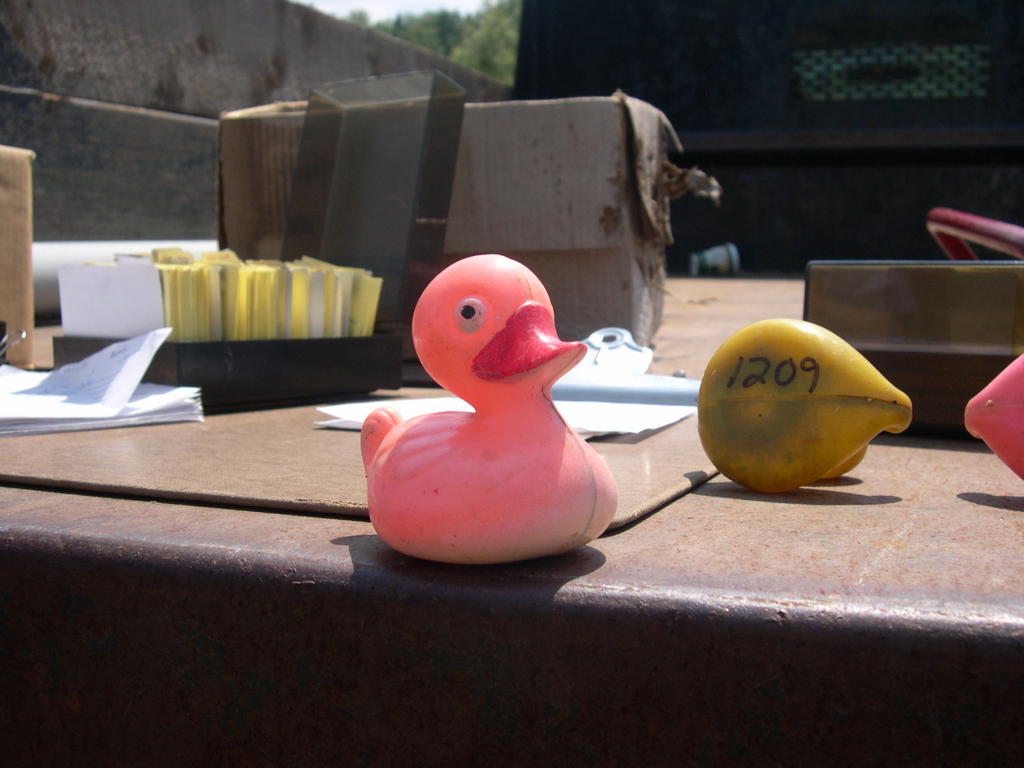
It was a weekend for puttering in the garden, test driving the hammock, and on the Fourth proper, sorting almost two thousand ducks for the famous Rotary duck race. At five bucks a pop, it is our largest fundraiser, and although it takes a lot of people to pull it off, most of the local Rotarians have been doing their duck race jobs for years. Duckmaster Ted leads the audit and sorting, ensuring that every ticket sold has a duck and that no duck races ticketless. Gary and the river crew have fine tuned the plastic pipe rigging that narrows down till only one duck at a time can squeeze through.

The barbershop based team hawks tickets at the Parade under the guidance of Rudy, who wears a stunningly awful duck shaped hat no matter how high the temperature soars. Every year at the meeting after the duck race, Rudy gives a happy dollar for the person who sprayed him down or insisted on a break in the shade, but particularly since the falling-off-the-roof episode, many would prefer that he not push the envelope so aggressively. It is in the nature of things that someday there will be a duck race without Rudy, but surely we need not hasten the day.

Back in my garage, where the ducks live year round, bursting forth only for this one annual riparian foray, the audit team works away. It takes five people to do the job, and this year we are fortunate to get a break for lunch before the last minute rush of last tickets. Desultory chat about possibly doing some steps differently fizzles. Certainly I don’t want to be the one to mess with tradition! I am the newbie here, only on my second year of duck racing, and it is restful not to be in charge. It is a shame to miss the parade—I particularly enjoy the many, many fire trucks and the agricultural vehicles on display—but we have ducks to deal with. We work away in the cool garage, in the company of old shepherd Max who is startled and uncharacteristically suspicious to see so many humans in his favorite cool spot.

In need of some appropriate music but with some trepidation, I put on the CDs from the 9/11 memorial concert. It turns out to be fine as long as we skip the first track, Springsteen’s My City in Ruins, which is still too much for me. I am hoping for the uplift I remember of that concert, but I will take my memories of the day itself properly muted, thank you very much.

Suddenly there is our last runner with the last tickets from the barbershop. It is time to go to the river! Too late, I realize this was the time for a top volume blast of the Commitments, Take Me to the River (and Wash Me Down). Maybe a new tradition for next year.

The river bank is teeming with babies, small children and their parents, all making an occasion of the duck race. There's the whistle and a few minutes later, there they come, thousands of tiny plastic ducks around the bend in the river. People are cheering and calling out their duck numbers. It’s over in forty-five minutes. Someone in Texas (imagine!) has won the thousand dollar first prize. I only know one of the winners of the other eleven prizes (a hundred dollars each), and I know he has bought so many duck tickets this year that his winnings scarcely make a dent in his overall contribution.

Roy and Doug scoop up ducks in fishing nets, collecting them in the bottom of a canoe. Small children re pressed into service collecting ducks, and many of them check numbers as they go, hoping to connect with their own duck. One wayward pink duck and one blue one are trapped in the eddies across the river and wait for rescue. These are the ducks you don't want to be yours, but who can blame them for wanting a little longer in the cool river on such a picture perfect Fourth?

Back at my house, the ducks are enjoying a few days on the lawn before next Monday’s sorting party to put them back in their boxes till next year. If we are lucky, Toby will bury only a few.

I snooze through the fireworks. Maybe next year, I will write about how odd it still seems to me that people come park on both sides of the road in front of my house and set up lawn chairs in the hayfields to watch the fireworks. Maybe next year it won’t seem odd, just another July Fourth tradition.

Now we take a breath, a day or maybe two to recover. It is a time for planning, strategizing, and getting ready. Maybe a little more time for play? When we exhale, summer will be almost over.

Tuesday, June 28, 2005

Living in the time of Oprah

This is embarrassing for me, a former literary scholar, the holder of two masters degrees, a community leader, to admit, but I enjoy Oprah. I also watch Dr. Phil and Nanny 911 and The Apprentice and The Cut. I used to watch Jerry Springer until it got so extreme that it went to pay-per-view, and I won’t pay to see it. Particularly in the age of digital video recording, when one can skip right over the annoying parts, it is mesmerizing to see the eternal struggles of humanity played out in variations.

I read murder mysteries for the same reason. I put a lot of time and energy into trying to untangle human motivation by observing activity, listening to spoken and unspoken intention, and exploring how different people’s realities collide.

I relate to Oprah, too, because we are almost the same age. And like Oprah, I am healthier, stronger, happier and more beautiful now than I was five years ago. Yesterday’s show focused on women who were dramatically more beautiful than they were a decade before, and the physical transformations were indeed dramatic and inspiring. That extra thirty pounds lost. The intent to keep a strong and healthy body. The conscious presentation of self to world by choosing clothing, hair and makeup. The personal tricks and tips ranged from the unsavory (putting Preparation H on your face every night) to the athletic (a woman who could stand on folding chairs and do a backbend to pick up a glass of juice in her teeth, then drink it down). Overall, Oprah had a good time with the show and with almost no mention of cosmetic surgery avoided drifting into the desperate territory of a Swan, which I do not watch.

There were mind games to try—put your alarm clock across the room and your sneakers next to it. The idea is that if you were standing up, the sight of your sneakers would guilt you into activity. Personally, I have become immune to guilt rays delivered by inanimate objects, so I would make a personal rule to put my shoes on before I was allowed to turn off the alarm clock. But then, I used to sleep in my exercise clothes.

By far, my favorite tip was one I discovered last year—wear pretty underwear all the time. Get rid of the grannies. Who wants to see those? I can’t tell you how often the image of a wisp of magenta lace in the ladies room mirror has lifted my spirits. Or how deeply reassuring it is to face a board meeting knowing that you are wearing your best matched black frills. A difficult conversation seems so much easier when you wear that ridiculous pink thong with the rose on the back. I can’t explain it, but it is true.

It is the rare fifty-year-old who can get away with wearing miniskirts, and I am not one of them. After yesterday’show, I might go for the next level of bodily improvement, but discretion bids a certain degree of coverage. But my underwear is my own affair.

Monday, June 27, 2005

Our own worlds

I have just finished Marilynne Robinson’s Gilead, which has impressed me more than any novel I have read in years. It seemed on every page there was some line about which I could write a whole essay. One of them was this concept (somewhere around page 197 in the edition I was reading):

Every single one of us is a little civizilation build on the ruins of any number of preceding civizilations, but with our own variant notions of what is beautiful and what is acceptable—which I hasten to add, we generally do not satisfy and by which we struggle to live. We take fortuitous resemblances among us to be actual likeness, because thos around us have also fallen heir to the same customs, trade in the same coin, acknowledge, more or less, the same notions of decency and sanity. But all that really just allows us to coexist with the inviolable, untraversable, and utterly vast spaces between us.

I have had thoughts somewhat like this before, though not expressed so elegantly. When I get annoyed at colleagues who routinely ignore messages, who prefer to remain ignorant of points of view other than their own, who walk into an emotional firestorm rather than unwind the tangled strands of motivation and passion—and this is in the professional world!—then sometimes I am able to see that I operate by a different set of rules than they do.

Professionally speaking, I was raised in a world that prized both conflict and courtesy. It is conflict that gives rise to new ideas, to advancement of group thinking in service of whatever ideal we may wish to serve. It is courtesy that allows for the fact that someone else’s idea may have more value than we see at first. And it is courtesy that keeps us from killing each other. Recognizing that I may be operating by unconscious rules that the other players don’t even know has made it possible for me to learn better negotiation skills.

In the personal world, too, I have recently come to recognize the need to explain the rules of my world. Most member of my immediate family (that is to say mom and siblings) are on maintenance contact right now. A variety of perfectly reasonable other issues in life—divorce, illness, joblessness, moving, and just living with small children—have caused family relationships—at least the ones with me—to fall away until there is really not a lot of interaction.

Do I believe they care about me? I guess. At least they would show up at my funeral. But like my colleagues, they don’t answer e-mails. My mother reads my blog, but I don’t think anyone else does. And the truth is that the blog was started, as was the group e-mail that preceded the blog, as a way to reach out, to help them know me a little better.

The truth is that they don’t know me as a person, and apparently don’t care to. I get birthday cards and Christmas presents and an occasional visit from one or another. I feel obligated to send Christmas presents and the occasional birthday card and—for some reason I have been the one to visit, more often than not. I send recipes from time to time, or a quick e-mail to say “I saw this and thought of you.” Most do not get replies.

I am careful to be as positive as I can be about each and every interaction, sending thank yous and reinforcing invitations. I even went on a group trip to Disney World, which was about as far from my idea of a dream vacation as it is possible to go. But I did it for the sake of growing connections.

What I get back from most of these relationships, most of the time, is slim pickings. I don’t get thank yous for Christmas presents. And last year one sibling sent me What Not to Wear, with a long and flowery note explaining that this was not a comment on my dress sense, just something to enjoy. It would have made a fine Christmas present if not for the fact that the previous year’s present was the identical book with an almost identical note.

Maybe it is time I get more explicit about my rules for dealing with family members. None of this represents any threat in any sense. How can you threaten people with the withdrawal of your attention and affection when those very things have so little value to them? And I know that as life happens, what we each need, every one of us, is more opportunities to continue to connect, not lines drawn in the sand. Still, almost everyone—there is an exception or maybe two—is on the maintenance plan right now.

To my family. Not to worry. You will still get Christmas presents, the occasional birthday card (somehow I have trouble remembering those), e-mails from time to time, and so on. At least you will get them as long as I have addresses for you.

Every year one sibling—whose sole idea for maintaining contact is to have children scrawl their names on a card—almost goes off the Christmas list completely. And every year, at the last minute, I can’t do it. Because I do value my family. And because no matter how serious the parent’s neglect of the gentle obligation to keep in touch, I want there to be options for the children.

I want the door always to be open. Open for what? Well might you ask. If the price of greater interaction with family members is that I need to take sides against other family members, that is simply not on. If the price is settling in for a cozy chat about how awful somebody’s spouse or ex-spouse is, I am not interested. I will not trade one family member for another. And if the price is giving up my own needs for a little quiet time during a visit, that won’t work, either. I am an introvert, you know! Or maybe you don’t.

I will still make the effort to visit down South once a year or maybe once every two years, if I am invited. But having noticed that the total of all the visits I have received over the last thirty years since I left the South is some fraction of all the visits I have made—for a lot of perfectly sound reasons, but still we are all adults now and all have engaging lives—I am unlikely to make more of an effort. I have come to realize that no matter how often I visit or how many ways I come up with to maintain contact, there simply is not much interest.

I suspect that if anyone in my family does read this, the first reaction will be to call and explain that I got it all wrong. Please don't. I know all about the press of daily life; I have one, too. I believe that people vote with their feet, not with their intentions. If you want the situation to be different, just act differently.

This state of affairs no longer offends, no longer hurts my feelings, but it does baffle. I think I am a pretty interesting person. The blog I started in part as a way to reach out to geographically and socially distant family members has blessed me with a new surprise. Apparently there are many people in the world who do find me interesting. In this day of internet and e-mail, we find our opportunities to connect no longer limited by distance. What a blessing that is!

Saturday, June 25, 2005

Reciprocity

Life in the city is easy. If you need something done, there are phalanxes of service providers clamoring for your money. And all it really takes is money, maybe a little oversight of the project, and quick like a rabbit your world is back in order.

Living alone in the country is different. Any illusion of self-reliance vanishes with the first big snowfall or the first downed tree limb. Here in rural America, we need each other, and we know it.

Musing today, my friend wasn’t entirely sure what makes her so grumpy with in-migrants, but she thinks it might be the lack of understanding of basic country courtesies, particularly of reciprocity. Of all the people that her husband had plowed out, of all the bundles of wood delivered as welcome presents, of all the gifts of time and heavy equipment, too few have been recognized as worthy of gratitude, far fewer of reciprocity. One returned brownies for firewood, and is held up as model of the rare in-comer who gets it. Vermonters are not happy, witless folk looking for opportunities to show off their tractors; rather they are over-obligated hard-working people who nevertheless make the time for those in need of help, however hapless the appeal. And however ungrateful the response.

It is reciprocity that is the name of the game here where winter really can kill and where people have lived in such close relation for so many years that they have come at last to recognize that different persons harbor different gifts.

I shared with my friend the technique I use here. In comparison to these people who have all manner of knowledge of the practicalities of country life, I know nothing. I have skills to offer, certainly, but it seems skimpy to offer an apple pie or a computer spreadsheet in exchange for the gifts I have received. And so, when I ask for and receive the gift of help hauling old carpet to the dump or even last minute dogsitting, I am wary that I need to reciprocate. Often I try to pay, and I have found the following phrase sometimes cuts through shyness and pride: “Hon, I really have to pay you. You know I can’t afford what you are worth, but if I can’t pay you something then I can never ask you again for a favor.” Pride meets pride, we agree to set it aside, and we are human together.

It is a humble thing to need to ask for help. I have good friends here, not people who invite me to dinner parties and chatter about the latest latest, but people to whom I can turn when a tree limb falls to ask who do I call? People who help without hesitation or question when I appear in tears over some small or not so small threat to my tiny treasure of a world.

Miracles have occurred in my life over the past few days. A confrontation that left me in tears was met by good friends who said, don’t worry…if we have to, we can build you a fence in a day or so. Ignoring the in-laws in the hospital, the daily demands of a small business. Here, they said, is what you do. But don’t worry.

I’m sorry, from another friend, the one who meant to build my fence sooner. Working for pay, his time is fractured in this halcyon season, but in hours he was in my yard full of apologies and re-engineered schedules. I thought I was waiting for you, but don’t worry. We can make it happen. Whatever happens, don’t worry.

Don’t worry, said my musing friend. It won’t be today or even this week, but we can bring the chain saw and take care of that tree that fell in your yard. Sure, you could call someone, but they will charge you, and we will take care of you. Because you belong here.

Did you want help with that? Another friend, my neighbor. Could you use the wood, I ask, or could I pay you? Definitively no. You kept our dog a really long time. I had forgotten the dog that came with my house, the dog who stayed on for a few months after we came to take over her family's former home. I had forgotten that I had reciprocity banked.

I am rich indeed.

Families

“Four girls and four boys he had, robustious little heathens, every one of them, as he said himself. But good fortune is not only good fortune, and over the years things happened in that family that caused some terrible regret. Still for years, it seemed to me to be blindingly beautiful. And it was.”

Doesn’t that just say everything about families? Blindingly beautiful. And terrible regret. Inescapable.

I am reading Marilynne Robinson’s Gilead and having the unaccustomed experience of savoring every page. I don’t usually have the patience even to read every page, so eager am I to get on with plot and life. But the woman has a gift. She understands what it is like to be alive, what it is like to live simultaneously knowing the blessing of your own life and the dismay when others judge.

“I don’t think it was resentment I felt then. It was some sort of loyalty to my own life, as if I wanted to say, I have a wife, too, I have a child, too. It was as if the price of having them was losing them, and I couldn’t bear the implication that even that price could be too high.”

People think I have chosen my life, and in many ways I have. I have chosen not to be whipsawed by others’ judgments, no matter how close to me they are, no matter how well-intentioned. But did I choose to be alone? Not really. Still, it has been a blessing to me to learn to love solitude.

I love my mother, my sister, my brothers, their families. I would like to know them better, as people rather than as the figurehead roles they prefer to play in my life. It is a source of unending sadness to me that they see me only as the one who left, the one who does not behave properly, the one who is to be judged and found wanting. I am expected to behave in certain ways because….well, just because.

I have definitively opted out of that game. But should anyone want to start a new way of relating, I would be all over that. Like white on rice, like a duck on a June bug, as they say down South, where I come from. And where I can never return.

Monday, June 20, 2005

Ungardening

The world and I have each done our share this weekend. I pulled out the knee-high weeds, carving out new garden vistas by what is no longer there, then mowed herb garden paths in more creative destruction. Finally, I put in a round of new plants, though this morning early I had to rescue one that Toby dug up to bury his morning milkbone.

I made a little headway on the lawn. I had to have it brush hogged, you know, after a month of wet weekends had spawned hip-high meadow that choked and broke my modest power push mower. The front is cut back to ankle height, and the side yard, but there are wide swaths of the back that are rapidly going back to meadow. Rapidly.

All the time, I worked around an enormous (think the size of a medium size tree) branch that fell in the night. Jeezum. How could a branch that big fall? Good thing it wasn’t closer to the house. This will be a new test of my emerging network of helpers. Who you gonna call? It has leaves, so does that make it good for firewood? Or do I just have a major disposition bill to face?

After a long day in the herb garden—but most satisfying as I reclaimed my paths and put in several dozen plants—I took a quiet walk over the the vegetable garden. I weeded only yesterday! Biomass has exploded everywhere, weeds flexing their vigor, robbing my poor little emerging veggies of water and nutrient. Gardening is easy in Vermont this time of year—which lasts only a few short weeks before the light changes, second cut comes, and we start to get ready for the snow again—but ungardening is even easier.

Entropy! Our only hope is to go with it.

Saturday, June 11, 2005

Instant gratification

Is there anything better than this?

I put the broccoli plants in last weekend, or was it the weekend before. Today I ate the pizza, lovely whole wheat pizza with thyme-roasted onions and grilled eggplant and red pepper flakes and oil-cured olives and the very first tiny broccoli flowers from those greenhouse-fostered plants.

Honestly, can you think of anything better?

Bookworm child

I do appreciate Jean passing the book meme to me. From childhood, I have found my best refuge in books. The summer I turned nine my house was a bookmobile stop. I remember the bookmobile ladies coming to my birthday party. It was the birthday that I remember hanging upside down on the neighbors’ monkey bars singing to myself, “It’s my party and I’ll cry if I want to” in mute protest.

It was one of the few occasions when my mother’s attempts to create a perfect child-centered word went badly astray. And who can blame her from trying? If I was nine, then my sister was six, the older of my two brothers four and the other a baby or not even. I was so excited when the girls up the road invited me to play, devastated when I came to realize that it was a put-up job to arrange a surprise party for me. I don’t think anyone has given me a surprise party since. And that’s a good thing. I was not a child who enjoyed surprises, nor do I enjoy them now.

An introverted and intelligent child, I never so much as tasted the easy cameraderie I saw others enjoy. Partly it was a numbers game, that in the tiny rural towns where we lived, there were few children with whom I had much in common. Partly it was the usual childhood stuff, learning to deal with the schoolbus bully and coping when best friends move away. But a lot of it was about learning who I am—introverted, intuitive, quiet but intense. I have a boisterous mask, but that has been slowly acquired to allow me to operate with people who are mostly very different from me. Those decades in New York were priceless in this effort!

From rural Georgia to Boston to Philadelphia to New York to Chattanooga and back to New York to here, my home in rural Vermont, books have been my best friend. From childhood, I curled up Jane Aiken Hodge’s The Wolves of Willoughby Chase, with Madeleine L’Engle’s A Wrinkle in Time, with Jane Eyre and Jane Austen. Like Jean, I initially missed the satire, but I craved the social observation. All these books I read over and over, along with anything that came as a Reader’s Digest book and any murder mystery. I loved plot and I loved characterization. I loved being taken to a different world. I still do.

1. Total number of books I’ve owned: Like Jean, somewhere between 2 and 3 thousand, but I have cut back to around 500 now. After years of hauling too many books around, I came to prize space and simplicity over objects, and disposed of all but the ones I really, really needed. This ongoing struggle against accumulation has required that I develop rules for what I really, really need, but in the degree that I successfully implement my own rules, I am free.

I have rules for clothes. If too big or too frumpy, it goes away. If you haven’t worn it in the last year, it goes away—unless you really, really love it. My rules all have the escape hatch for what you really, really love.

I have rules for food. If it’s not good for you, it doesn’t come in the house. If you ought to be eating it (vegetables!) buy it, plan a recipe, cook it, so that you have the option to do the right thing. Any waste is readily justified on the basis of option creation and compost.

And I have rules for books. Now I have my core books—probably no more than a hundred or so—and I have provisional books which are on their way through my home. Some of the provisional books are murder mysteries that I don’t need to own on literary merit, but it is handy to have a spare few just in case I hit a day when I have nothing to read and can’t get to the library. Some are home improvement or decorating or travel books that are handy, even if they aren’t—properly speaking—essential to my well-being. It got to be such a burden getting rid of books, that I have all but stopped acquiring them. Libraries fill the gap.

There are books I treasure because they bring me back to a part of my life. My foreign language dictionaries for college. Michael Porter’s Competitive Strategy for business school. A bond math handbook for those years at the bank. The Book of Common Prayer. Christopher Robin and Le Petit Prince. A strange little novel, not very good, called On the Marais des Cygnes written by my great-grandfather. My mother recently sent me some volumes of a children’s magazine called St Nicholas from the twenties that I pored through as a child, particularly the stories told around any three random objects: a spider, a bicycle and a bad boy, say.

There are books I keep because they said something to me once, or because I sense that they have something yet to say to me, although I cannot read them now. The former includes May Sarton’s books and James Hillman’s and almost all of Annie Dillard, although these days I find Dillard overly wordy and mostly unreadable. The latter group are the books I tried to get rid of but they would not let me: Isak Dinesen and George Eliot and my complete Shakespeare plays comprise a few examples.

Cookbooks, of course, have completely separate rules.

2. Last book I bought: Kay Redfield Jamison’s Exuberance, because I need to own it.

3. Last book I read: I just finished Margaret Drabble’s The Red Queen. Margaret Drabble is one of those writers whose work I will always read. Her books stay with me—literally and figuratively—for a long time. It took me about three weeks to read this book, which is quite unusual, since most books don’t last me three days. I don’t think it is her best work, but it is extremely interesting in the interplay of multiple plot lines and the blurring of one story into another. I particularly relate to the theme that we are each writing the story of our own lives—that the way we tell our own story is of supreme importance and that stories clash in the ether.

4. Five books that mean a lot to me: The Master and Margarita, by Mikhail Bulgakov. I wrote my master’s thesis on this book, which still speaks to me. Layers and layers and layers. If I had to pick only one book that meant the most to me, it would be this one with its echoes of Goethe’s Faust, its overlay of rose petal fragrance, and its exquisite rendering of the battle between light and darkness.

My favorite gardening book, Landscaping with Herbs by James Adams. Fragrance and flavor, wrapped up in beauty. And you can have it at home.

If I were able to pick something for the Christian tradition it would have to be Thomas Merton or CS Lewis or Thomas Moore or Henri Nouwen, but I don’t know how to pick. Maybe the Book of Common Prayer. The Bible seems an obvious pick, but somehow that is not so much a book to me as a more complex object, its impact both sharpened and blunted by how others have used it as an instrument of social conformity. Lately, I am branching into some Buddhist paths with Thich Nhat Han.

Heinrich von Kleist’s On the Puppet Theater is not so much a book as an essay, one that is so important to my world view that I quoted almost all of it elsewhere in this blog. http://vtdiary.blogspot.com/2005/01/end-times-in-garden.html

Among self-help books, I would have to pick Maggie Scarf’s Unfinished Business or Kay Redmond Jamison’s An Unquiet Mind, or even Parallel Lives: A Study of Victorian Marriage, by Phylis Rose, because she gave me a way to think about what marriage is not. I agree with Jean’s pick of The Highly Sensitive Person, by Elaine Aron, and would add The Introvert Advantage by Marti Olsen Laney. Who could ever suspect that extroverts think we are ignoring them on purpose? We introverts are simply not particularly interested in extroverts’ flapping and fluttering, but that, I suppose, is what offends them. And who could have imagined that extroverts routinely talk without thinking first? I am offended by that.

Murder mysteries and cookbooks—I can’t begin to pick. The truth is that despite an MA in comparative literature and an MBA to follow, these are the categories of my daily fare. Maybe another essay another day.

5. Which five bloggers am I passing this to? Since we have already established in the previous section that I either cannot count or cannot play by the rules—or perhaps this overly conforming child is finally learning that I don’t always have to—I am passing it to any of you who want to do it. Despite my blog-absence of the last few months, I confess to feeling a slight reprise of those childhood slights that I wasn’t asked earlier. I was always the last picked for kickball, too. But I would have done this particular meme eventually even if Jean had not asked, since I am grown up now and I write about what I like. If something in my piece speaks to you, please do respond, but many of my favorite bloggers have done this one already. It would, as always, be great to hear from Robert at Beginner’s Mind http://beginnermind.blogspot.com/ or from Susan at Visual Voice-Net http://www.visual-voice.net/ but if I have missed your booklist in my absence, please forgive me.